

Real-world performance. Real differences.
The CME H12MIDI Pro was developed together with the community. Conversations with early backers sparked an interesting topic: how does the H12 compare to another well-known MIDI solution, the iConnectivity mioXM?
At first glance, both products seem similar:
- Advanced MIDI routing
- Standalone operation
- USB host functionality
- Preset management
Both are powerful MIDI interfaces, but they are built with different workflows in mind.
This blog compares the H12MIDI Pro and mioXM in real-world setups and explores why modern musicians increasingly choose more flexibility, power, and connectivity in a smaller footprint.
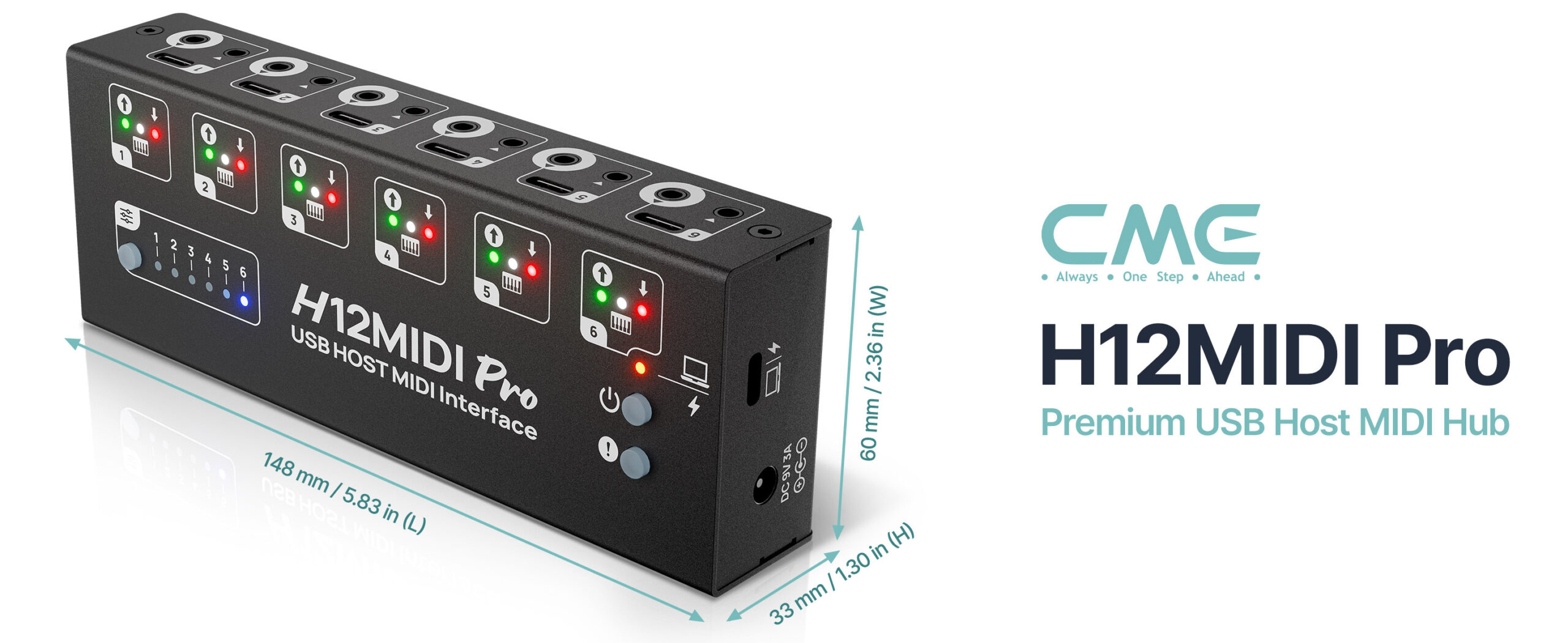
Scenario 1: Your setup is getting more compact
Modern MIDI setups look different than they did a few years ago.
Today’s workflows often include:
- Compact synths, even mini-synths
- Portable samplers
- TRS MIDI gear
- Advanced USB MIDI controllers
- Tablet and smart device integration.
This is where the differences become immediately visible.
iConnectivity mioXM  Designed as a central studio routing system
- 214 × 140 × 37 mm → 8.43 × 5.51 × 1.46 in
- 992 g → 2.19 lbs
- Desktop / rack-oriented form factor
CME H12MIDI Pro Designed as a portable MIDI brain
- 148 × 60 × 33 mm → 5.83 × 2.36 × 1.30 in
- 200 g → 0.44 lbs
- Similar footprint to a compact guitar pedal
With only around 20% of the mioXM’s weight, the H12MIDI Pro is built to go anywhere: sessions, live gigs, rehearsals, or directly onto your pedalboard.
About the size of a modern smartphone, the H12 is also fully focused on portability and compact setups without compromising connectivity or power.
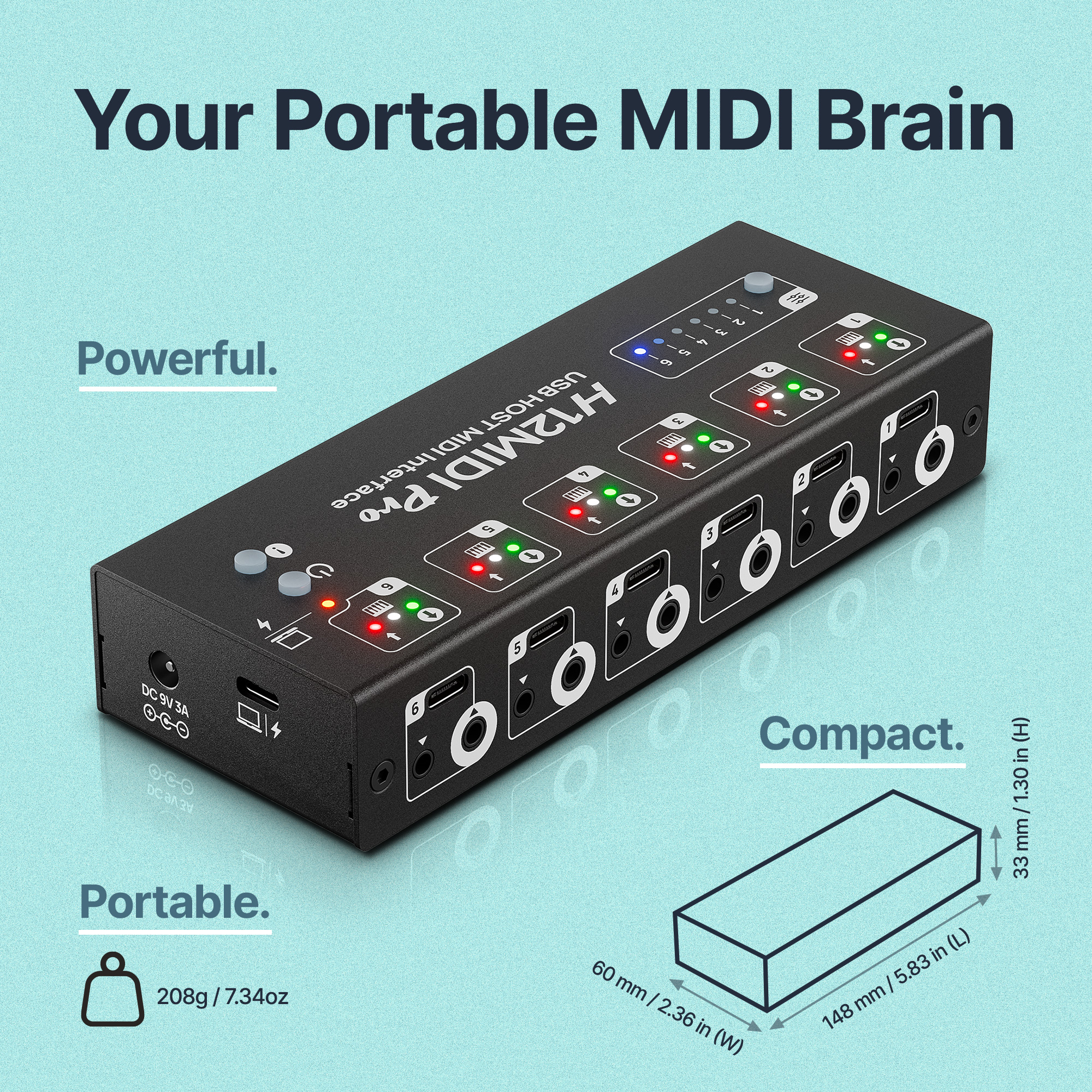
Scenario 2: Modern power requirements
Power matters more than most people realize. Not just powering the interface itself, but also powering the devices connected to it.
iConnectivity mioXM Designed for fixed desktop/studio use
- Requires external power supply
- Always tied to wall power
- Up to 2A available for connected USB MIDI gear
CME H12MIDI Pro Built to adapt to studio, stage, and mobile setups alike.
- USB-C powered (laptop, adapter, power bank)
- Optional 9V DC input for pedalboard integration
- Up to 3A available for connected USB MIDI gear
While the mioXM is mainly built for fixed studio setups, the H12MIDI Pro is able to connect with more USB MIDI devices and offers greater flexibility with USB-C (5v) and pedalboard compatibility (9v DC) - making it a stronger fit for modern and hybrid workflows.
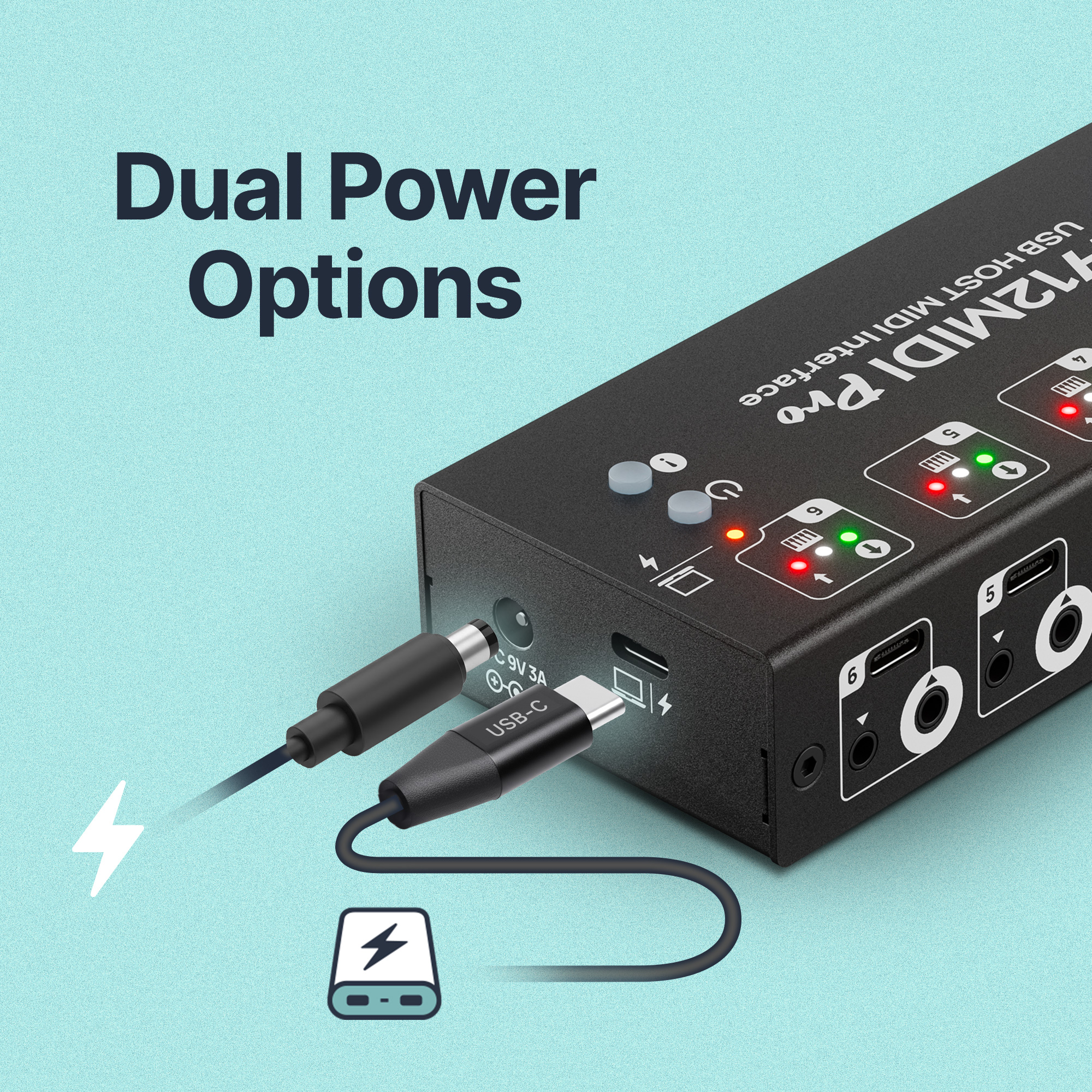
Scenario 3: Ports & flexibility
This is where the design philosophy between both devices becomes very clear.
The iConnectivity mioXM focuses heavily on RTP-MIDI and network-based workflows, making it a strong solution for larger studio infrastructures and multi-computer environments.
The CME H12MIDI Pro, on the other hand, is built around a modern USB-first approach with direct hardware integration and fast standalone workflows.
iConnectivity mioXM Strong focus on network routing and RTP-MIDI
- 4× USB-A host ports
- Up to 8-in / 8-out virtual USB MIDI host ports
- 4× 5-pin DIN MIDI IN / OUT
CME H12MIDI Pro Direct USB hardware integration without network complexity
- 6× modern USB-C host ports
- Up to 16-in / 16-out virtual USB MIDI host ports
- 6× TRS MIDI IN / OUT with switchable Type A/B
The key difference?
The mioXM is still centered around a traditional DIN + network workflow.
The H12MIDI Pro is built around how musicians increasingly work today:
- USB-first
- Compact hardware
- Hybrid connectivity
- Flexible device integration
The H12 is designed to connect more devices directly and simplify modern hybrid setups. And if 5-pin DIN is needed, CME offers dedicated TRS-to-MIDI cables with an ultra-low-profile design, helping keep compact setups clean and space-efficient.
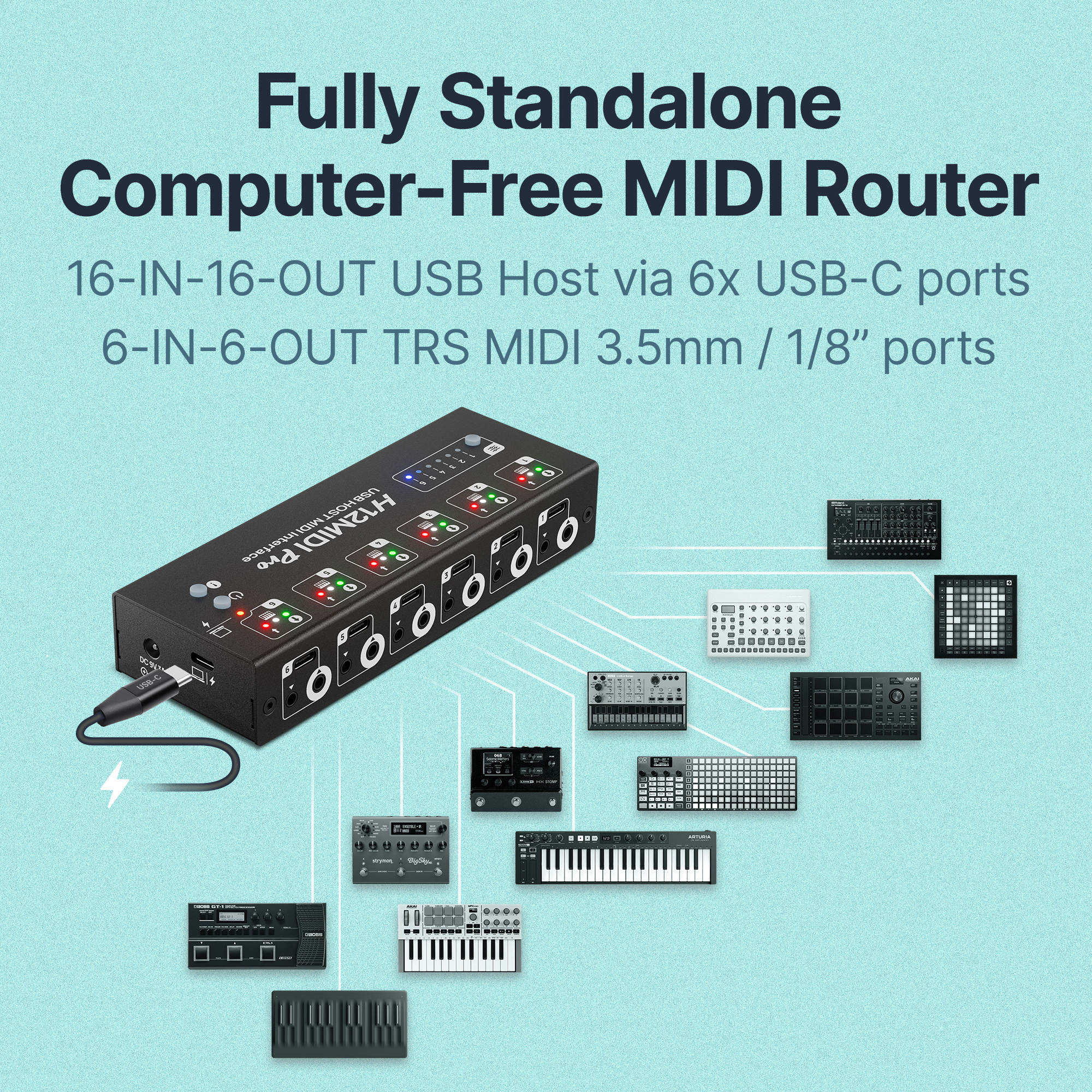
Scenario 4: Presets & workflow flexibility
The workflow difference between both devices becomes especially clear in live use versus fixed studio environments.
iConnectivity mioXM Best suited for permanent setups
- 4 onboard presets
- Recall from the front panel
- Limited visual feedback
CME H12MIDI Pro Built for flexible, live and hybrid workflows
- 6 onboard presets
- Switch via panel or MIDI messages
- 25 Smart LED visual feedback system
The mioXM is optimized for structured studio routing and permanent installations, while the H12MIDI Pro focuses on fast, real-time workflow control.
For musicians working with evolving setups and live performance scenarios, the H12 offers a more flexible and direct experience.

Scenario 5: Pricing - The honest takeaway
The iConnectivity mioXM remains a strong solution for fixed studio environments, DIN-centric workflows, and RTP-MIDI networking.
The CME H12MIDI Pro, however, represents a newer generation of MIDI workflow - focused on portability, direct USB integration, flexible powering options, and modern hybrid setups.
At US$ 199.99 for the H12 versus US$ 249.99 for the mioXM, the H12 not only delivers stronger value for money, but also offers:
- More available power for connected devices
- More USB and MIDI connectivity
- More presets for live workflow control
- A dramatically smaller and lighter footprint
For musicians looking for maximum flexibility, connectivity, and portability in a modern setup, the H12MIDI Pro simply delivers more.
Header | CME H12MIDI Pro | iConnectivity MioXM |
|---|---|---|
Form | Compact / portable | Desktop / rack-style |
Dimensions | 148 × 60 × 33 mm // | 214 × 140 × 37 mm // |
Weight | 200 g // | 992 g // |
Power | USB-C + 9V DC | External 12V PSU |
USB host ports | 6x USB-C (16 I/O virtual) | 4x USB-A (8 I/O virtual) |
MIDI ports | 6× TRS 3.5 IN/OUT A/B | 4× DIN IN/OUT |
Network MIDI | X | RTP-MIDI |
Presets | 6 | 4 |
Workflow | Portable hybrid setups | Studio routing systems |
Price | US$ 199.99 | US$ 249.99 |
I have a very simplified midi set up I’m trying to figure out. I have a Keyboard that I want to control another keyboard with the H12Midi pro. I got a red and green flashing light on channel one input and output. I’ve tried to configure on the computer but honestly, I have no clue how to program to function my master synth to control and play my slave synth. Any help would be appreciated. I just got my H12Midi pro in yesterday.
Hi Ronald, you need to start with downloading HxMIDI Tools and set upo your routing. It is basically connecting inputs with outputs. You can find more details via https://www.cme-pro.com/start-guide-for-uxmidi-tools-software-by-cme/
If you require any personal guidance afterwards, please contact http://www.cme-pro.com/support